Showing posts with label tyres. Show all posts

2014-08-26

New rims with stickers on


New 13" rims from Force Racing, 7" and 9" wide with brand new Dunlop slicks - "stickers".

I bought the rims directly from Force Racing this time and they were very easy to deal with and I can really recommend them.
The rims are very lightweight - only 3792g/3528g according to my kitchen scale* and look stunning.  If you want to order yourself, refer to this post and they know what to do.

Note that you need to modify your rear calipers to fit 13" rims on a CSR!

The slicks are the same dimensions I usually run - used Radical PR6 slicks 230/570/13 and 190/535/13 - but this time in soft compound instead of medium which the Radicals run. We'll see how that goes. I bought them from HP Tyres. The rims are a bit narrow for these tyres, but I think they work ok.

I plan to practice on worn used slicks and put these on when I really want to go for it. I've already started building a simple rack for my trailer.


* - my kitchen scale is known for messing up recipes 

2013-09-09

Thermal camera


During the last F1 race they've equiped some of the cars with thermal cameras. How cool is that??

Notice how fast the tires cool on the straights, and how much heat is generated from just a small mistake. Some interesting words about it here. I also wrote something about wide tyres and heat a while ago, here.

Of course you'd want a camera like that yourself. The problem is that the price tag for an entry level thermal camera is several thousands of dollars.

There is soon a solution for that. Check out this camera that you attach to your smartphone. The estimated retail price is "just" $325!


2013-04-07

Does wider tyres equals more grip?

On a thread on Pistonheads someone claimed that wider tyres doesn't mean more grip.

Theoretically, the tyre size does not change grip as Amontons 2nd law states that friction force remains the same. The tyre size is really about matching width to the amount of energy being transferred to the ground, i.e. narrower tyres will run hotter.

Before I get shot down in flames, there are many other factors but the principle that a wider tyre will provide more grip is not necessarily the case unless you have the power to keep them warm.

I would say that the author of that comment is both right and wrong. The reasons why is far from obvious. I'm not an expert in any way but I do enjoy reading up on subjects that interest me. Race car rubber is one of them! But please take it for what it is.

Contact patch
Contrary to common belief the contact patch is not bigger with wider tyres, with the same internal pressure. The contact patch is calculated with area=load/pressure. With wider tyres the contact patch is obviously wider than with a narrow tire, but the area is the same.

Amontons 2nd law is tempting to use here, but rubber's friction is not that simple. Rubber generates friction in three different ways: adhesion, deformation, and wear. The generated friction force is not linear and very complicated.

Slip angle
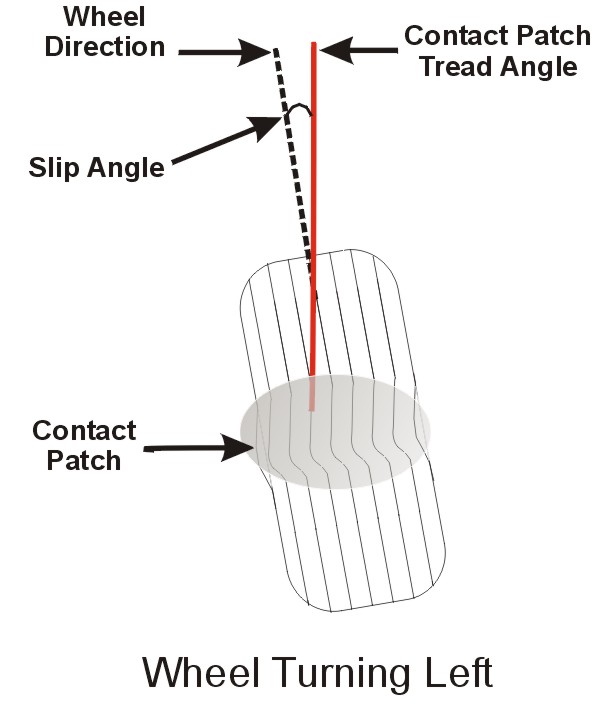
Slip angle is what generates grip, or to be more precise - lateral force. When a race car is cornering, the slip angle is the difference in what direction the tyres are pointing and the direction the car is heading. A race car generates maximum lateral force around 7-11 degrees of slip.

The term "slip angle" is a bit missleading, as with small slip angles there is no slip in the contact patch. In fact, it is the elastic nature of rubber that does the work here.

Lateral deformation in the contact patch
This is where the magic begins. The lateral force is generated by the tyres resistance to deflection. The deflection is not the same along the contact patch, but is built up gradually, non-linear.

So what is your point??
That wider tires do provide higher levels of lateral grip, because the wider contact patch leaves more room for the tyre to resist deflection. And resistance for deflection = force.

And heat?
More grip = more energy = heat. Too much of it means overheating, to little means cold tires. Wider tyres get warmer (not cooler) than narrow tires, because they generate more lateral force! They also cool faster than narrow tyres, because they have a larger surface area. And that is what makes it problematic.

Conclusion
Wider tyres = more grip in the corners. If you don't utilize the higher level of grip, they'll cool too much on the straights and they'll be outside of optimal temperature range.

Source and recommended reading:
The racing & high-performance tire - Paul Haney

When I wrote this post I sent an email to Paul to confirm a few thoughts. He wrote back to me within an hour - respect!

2012-08-28

Mantorp - slicks vs CR500

Mantorp, again. A new personal best, again - 1.21,8!!! That is 1.5 seconds faster than last time, and I haven't changed anything except put on a new set of (second hand) rubber. I never thought I could reach laptimes like that!

At the end of the day I mounted a set of standard 15" rims with Avon CR500 tires just to see the difference compared to the Dunlop Radical slicks. 1.24,8 or 3 seconds. That is a big difference, no questions about it, but with the CR500 the car suffered tremendously from understeer and I think the difference would be less if I took the time to adjust the suspension to suit the tires better. Not to mention tires with better dry performance than CR500.

Slicks in red, CR500 in blue.

I also put zip-ties on the damper rods and that confirmed my suspicion that the front dampers bottoms out onto the bump stops. I don't know if it is while cornering or while braking, but that is something I should look into next time.

Riding on the bump stops is not necessary a bad thing. Read an article here.

2012-05-07

2011-11-03

Trackday slicks part #3 - Fitting 13" rims

The rear brakes on road CSR's are to big to fit inside 13" rims, which makes the availability of tyres a bit limited. Most suitable slicks are 13" and if your're looking for second hand, 15" slicks are like water in the dessert. (see my previous email conversation with Avon)

I recently found myself a source for second hand Radical slicks at a very good price, so I decided to do whatever it takes to make 13" rims fit my car.

I ordered these nice looking split rims from Simon at 7tips, who were very helpful.


After a bit of grinding on the caliper cooling fins the rims fitted with 1.5-2mm clearance. The most grinding was on the inside part of the fins. It was an easy job to grind the calipers. Put the car on axle stands and start grinding. Measure caliper clearance by crawling under the car and measure from the inside with a feeler gauge.


Before
After


Unfortunately the hydraulic brake hose connector just barely touched the inside rim edge, so I had to either modify the connector, or put a thin spacer plate on the wheel hub.

Brake hose connector touching. Photo from the inside


Since I was concerned the wider tyres might touch the rear fenders I decided to use a banjo fitting to the calipers instead of spacers. After lots of searching for a what I thought would be a suitable banjo adapter I ended up ordering new brake lines with pressed banjo fittings. Unfortunately there was a misunderstanding with the supplier (who also was very helpful), but to keep a long story short I bent the banjo fittings myself. No problems, and the end result was good, but this can probably be done in a more clever way. It might not be necessary to have new hoses made up if you put some more effort into this. I also had to grind a small edge to make the banjo fit the caliper.


Rims
7" x 13" et40 - 139mm backspace
9" x 13" et30 - 158mm backspace

Simon at 7tips said my requested backspace on the rears was between sizes, so the backspace I got differs some than the CSR rims from Caterham (but I haven't checked how much). Be careful not to have too little backspace or the wheels will foul the rear fenders. With about 1.5 degrees of neg camber I have just about 5 millimetres to spare with my wide Dunlop slicks.

Weight
I compared the weight between my 13" 7tips wheels and 15" Caterham.

15" Caterham rims with very worn ACB10: 11.3 kg front, 14.3 kg rear
13" split-rims with wider Dunlop slicks: 9.0 kg front, 10.6 kg rear

That is a difference of 12 kg rotating inertia mass total! Using this spreadsheet that would estimate around 70kg lower chassis weight.

New brake lines (instead of spacers):
Banjo 12mm (long version)
Hose connector straight 3/8-24 conc female
Hose length 60cm (minimum, plus connectors)
Banjo bolt M12x1mm
Washers (two per caliper)
I ordered mine from NBM Hydraulic

The standard brake lines are 3/8-24 in both ends.

Spacer plates (instead of banjo fittings)
PCD 4-108 63,3mm M12 Ford standard.

They sure look fast!


Disclaimer
Beware, this is on your own risk! I have no idea how this affects caliper strength or heat transportation. I also don't know how much the calipers flex when braking hard, and I still haven't test driven this. But from my limited knowledge I don't think this will affect strength much.

If you believe it was too much grinding, MOG Racing sells a kit which also includes modified brake hose connectors.

UPDATE: Now I have tested them on track.

See also
Trackday slicks part #1Trackday slicks part #2 and Trackdays slicks part #4

2011-10-15

Mantorp, last time this year

A sunny but very cold day started with below zero degrees Celsius. The cold asphalt made the car both oversteering and understeering in different corners and all I could do was pretty much just play around. Late in the afternoon the temperature increased and the grip was much better.

On one of the day's last laps I beat my personal best: 1:27.7 on a very old set of ACB10!

I also met up with my new "pusher", who sold me one and a half set of second hand slicks at a very good price. Hope this works out, it would make a significant effect on my personal economy.


More about that later.

2011-09-20

Trackday slicks part #2

I emailed Avon asking for recommendations regarding slicks on the CSR.


Hi Niclas,

As you probably know, the racing CSR run 9”X13” front wheels and 10.5”X13” rear, we developed some radial slicks specifically for this application for use in the CSR Eurocup.

195/530R13 A24 compound
250/570R13 A24 compound

With 15” wheels things are a bit more difficult. I would recommend using radials on a CSR as the car was designed to work best on them (most other Caterhams work better on a cross-ply) but unfortunately we do not make any radials in suitable constructions and compounds for this car in 15”. The cross-ply tyres you have a probably the most suitable we have available but again, these are not perfect due to the split of compound front to rear (A24 front A56 rear).

The cross-ply tyres will only require a small amount of camber, far less than the radial set-up the car would have been built to.

Sorry I can’t be more helpful.

Regards,

Xxxxx


And after a follow up question:


Hi Niclas,

I’ve done a little digging and you are absolutely right, they did run 7” and 9” which were a little bit narrow but seamed to work well.

We have replaced the 175/550R13 front with a 195/530R13 spec number 13800S – it’s actually the same size (don’t ask).

The rear 250/570R13 spec number 9906S is still current.

I’d go with the 7s & 9s and get the necessary rear brake changes done.

Hope this helps.

Regards,

Xxxxx


See also Trackday slicks part #1

2011-06-23

Trackday slicks part #1


I've bought a set of 15" Avon crossply slicks!

For a while I've been tempted to try slicks. 15" slicks are expensive and hard to find second hand. Fitting 13" rims is not possible on the road version of the CSR without modifying the rear brake calipers. MOG racing sells a kit for conversion to 13" rears, but it is rather expensive. I've also considered to just shave the caliper with a grinder, but after a bit of measuring I thought it would be too much of shaving to feel comfortable.

I'd also like to keep my crossply-setup so I can go back to ACB10 without too much hassle, so crossply slicks would be of preference, but many people recommends radial slicks.

Anyway the urge for slicks became too great to resist so until I feel comfortable on spending money on new rims and conversion kit I bought a set of Avon 15" crossply slicks. A financial disaster and probably not a very good idea for the long run but I couldn't resist.

Comparison between my current ACB10 and ACB0 slick tyres:

TreadDiameterCompound
ACB10 8.0/22.0-15 (215/40-15)206 mm561 mm?
ACB10 7.0/22.0-15 (195/45-15)180 mm551 mm?
ACB0 8.7/21.5-15213 mm561 mmA56
ACB0 7.0/21.5-15177 mm561 mmA24

ACB10 tread rear/front:1.14
ACB0 tread rear/front:1.20
ACB10 rake: rear 5mm higher
ACB0 rake: 0 mm

More rubber on the rears and less rake. Maybe I'll get a bit of understeer?

Sources:
http://www.avonracing.com/
http://csr.informe.com/forum/csr-track-day-slicks-dt66.html
http://www.pistonheads.co.uk/gassing/topic.asp?h=0&f=101&t=1010028&mid=179024&nmt=CSR+Slicks
http://www.westermann-motorsport.com/shop/product_info.php?info=p300_Conversion-for-CSR-to-13-.html

2011-06-15

Wheel alignment check


My current wheel alignment, measured in my garage. Cross-ply setup.


FrontRear
Toe0.5° out0.7° in per wheel
Camber-1.25°-0.25°±0.25°
ARBHard setting-
Tyre195/45-15215/40-15ACB10 road legal
Pressure19 psi19 psiwarm
Rims6.5"-159"-15


Rear left wear
Front left wear

The wear in the middle came after running a bit too high pressure on Mantorp earlier this year. I think 19 psi is just right. I know that sounds low, but it works for me.

My rear 9" rims are too wide for the ACB10 according to Avon, but it works ok.

2011-02-25

About using nitrogen in tyres

There are different opinions about using Nitrogen in tyres instead of ordinary air. I did some research and here are my conclusions regarding nitrogen and track driving:


The Ideal gas law says there are no difference between different gases regarding temperture vs pressure relationship. Many people use that as an argument for that air works just as fine as nitrogene.

However, if the gas contains moist, the number of mol of gas changes when the water changes state between liquid and vapor. The Ideal gas law also says pressure is relative to number of mol of gas and the amount of vapor a gas can carry is relative to temperature. So with a gas containing moist, the pressure relationship to temperature is not linear!

Any gas can carry moist, even nitrogen. The difference is that nitrogen is produced by cooling air, removing any possible moist. Diving air is also completely dry for the same reasons.
Air for divers and tyres

So my conclusions are that any dry gas is more predictable than humid air. Dry air works just as good as dry nitrogene. The benefit with a completely dry gas is a linear temperature-pressure relationship. Remember that you have four wheels and the chance you have exactly the same amount of moist in all of them is not very likely.

With that said, I did try nitrogen once instead of my normal gas-station air and couldn't find that much difference, but I tend to drive a handful of laps and then check and re-adjust my tyre pressures over and over. For those who have to start a race with cold tyres I can clearly see the benefit.

To be able to fill a tyre with nitrogen or dry air you must do it several times before all humid air is out. With stiff side-walls and low tyre pressure it not easy to get all out.